












Deep in the mountains of southeastern Yunnan lies Heizhiguo Township in Guangnan County, enveloped in lush greenery. Blessed with a mild climate and fertile soil, the region has long suffered from low agricultural benefits due to rugged mountain roads and a monotonous industrial structure.
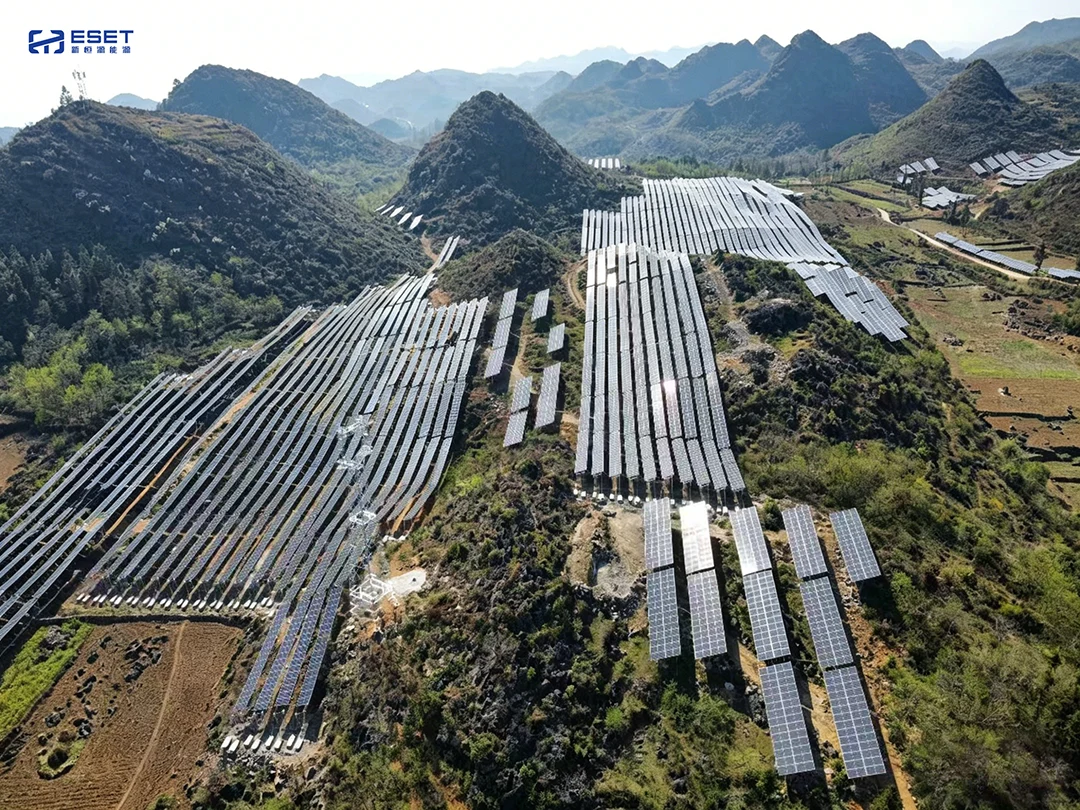
One autumn day, the exploration team from ESET SOLAR ventured into these mountain valleys and was struck by the local scene. Villagers toiled diligently on sloped farmlands, relying on traditional crops such as star anise and sugarcane merely to make ends meet. Abundant sunlight hung over their heads, yet it had never been turned into tangible income for the locals.
What mattered most to the villagers was straightforward and practical:Will we still be able to farm our land once the PV panels are installed?
Prioritizing green energy development while safeguarding cultivated land became the core principle at the launch of the project. Meanwhile, a host of technical challenges emerged:How to adapt photovoltaic systems to complex mountainous terrain?How to balance sunlight demand for power generation and crop cultivation?How to preserve soil and water ecology during construction?
Characterized by steep slopes, rocky terrain and thin soil, Heizhiguo Township was unfit for conventional PV bracket solutions. During the design phase, ESET SOLAR’s engineers moved their workflow straight into the mountains. Equipped with surveying instruments, they conducted on-site investigations alongside the general contractor day after day. Covering every slope in the area, they collected over 5,000 survey points and created a high-precision 3D topographic map, laying a solid foundation for technical breakthroughs.
The team ultimately adopted a flexible system. Spanning 21.7 meters in single span, the system stretches like a giant mesh that naturally conforms to the undulating mountain landscape. Precisely tensioned and anchored steel strands form a rigid yet flexible plane, allowing slight elastic deformation while maintaining structural stability.
Under strong winds, the cable net deflects and twists marginally, automatically adjusting the windward angle of PV panels to reduce instantaneous wind pressure and dissipate wind loads effectively. Pre-stress technology precisely tunes the structural natural frequency, keeping it clear of the vortex shedding frequency within the designed wind speed range, fundamentally eliminating damage caused by vortex-induced vibration.
Compared with traditional solutions, the number of pile foundations is cut by approximately 60%, eliminating the need for large-scale land leveling. For under-panel farming, shade-tolerant, high-value crops such as edible fungi and Chinese medicinal herbs are prioritized. The bracket is set at a height of 2.5 meters, leaving ample space for manual harvesting. The team also built a linkage regulation model integrating sunlight, crop growth and power generation. Aligned with crop growth cycles, PV panels are fixed at an optimal inclination of 20 degrees, enabling precise allocation of sunlight between power production and agricultural planting.
Project construction faced severe hurdles including mountain slopes of up to 40 degrees and slippery mountain roads in rainy seasons, alongside stringent ecological protection requirements. Working closely with the general contractor, the ESET SOLAR project team adopted an innovative minimally invasive construction process tailored for flexible brackets.
Leveraging high-precision GNSS positioning technology for accurate construction, random excavation was strictly prohibited. Lightweight cable net tensioning technology reduced the operation of heavy machinery, minimizing disruption to the original mountain ecology. The two parties jointly planned construction routes, avoided protected vegetation, implemented closed waste disposal throughout the process, and ensured full site restoration upon project completion. The result was harmonious progress of PV construction and ecological conservation.
In 2024, the 88MW Heizhiguo Flexible Agri-PV Complementary Project was fully connected to the grid. Rows of PV panels stand neatly across the mountain slopes, while edible fungi and Chinese medicinal herbs thrive beneath them, unfolding an idyllic landscape of power generation above and farming below.
Shaded by PV panels, soil moisture evaporation is reduced and surface temperature drops by 5–8°C, creating ideal growing conditions for shade-tolerant crops. The project has driven substantial local employment, drawing many migrant workers back to their hometowns to earn a living locally. Meanwhile, the project delivers an annual power output of 1.32 billion kWh, enough to supply electricity for around 200,000 households.
From an isolated mountain enclave to accessible green energy hub, and from single farming to diversified integrated development, ESET SOLAR’s Heizhiguo project leverages flexible technology to resolve the dilemma between mountain energy development and agro-ecological protection. It serves as an exemplary model for advancing rural revitalization alongside national carbon peaking and neutrality goals.
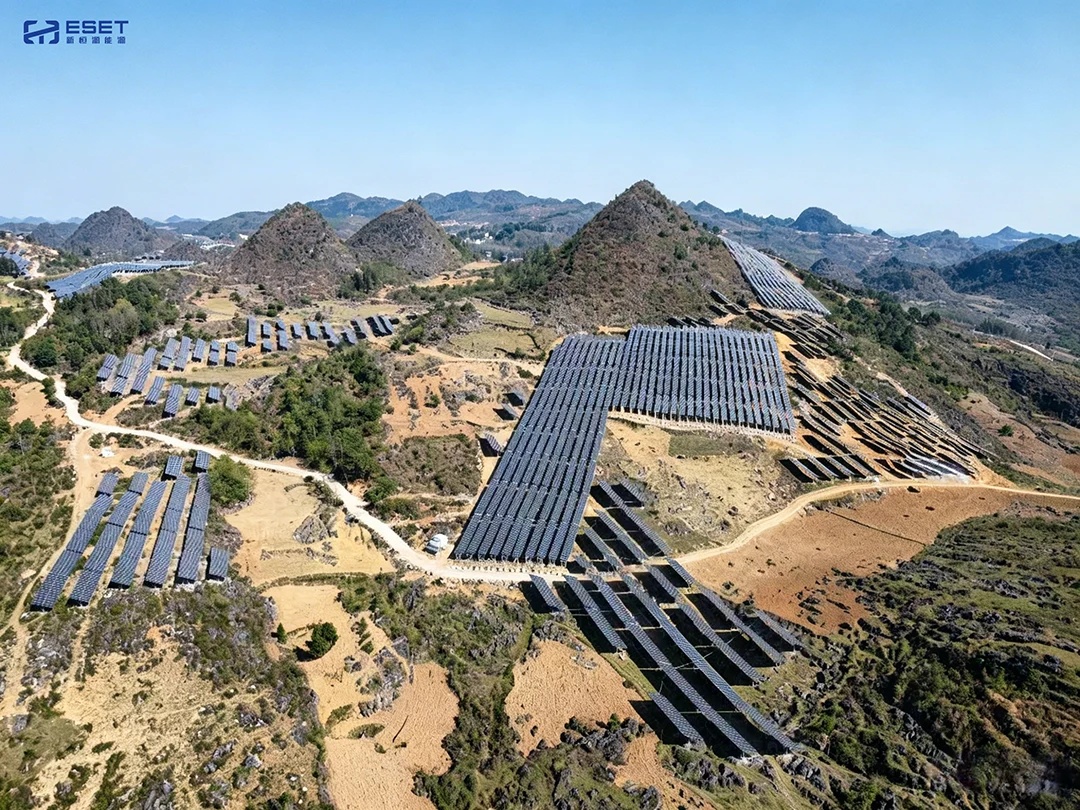
Here, photovoltaic power coexists in harmony with rural farmland, and energy development achieves win-win progress alongside people’s livelihoods. Beyond building a green power station amid the southeastern Yunnan mountains, ESET SOLAR has cultivated a promising landscape of sustainable development.