






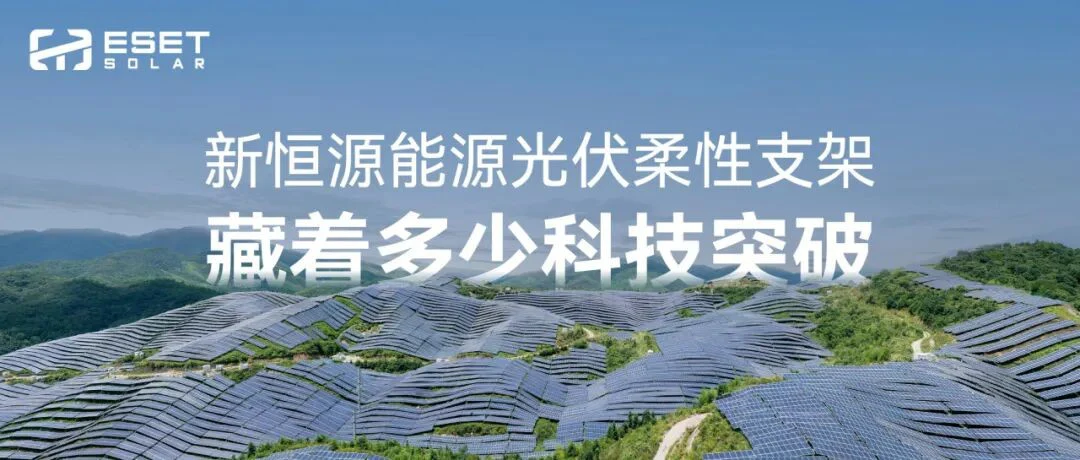
At first glance, ESET Solar’s flexible PV mounting structure looks deceptively simple: just several steel strands and mounting pillars elegantly spanning fish ponds, mountainous terrain and gullies. Beneath this minimalist appearance lies sophisticated structural engineering and groundbreaking technological innovations.
Breakthrough 1: Flexible Joints for Terrain Adaptability
Flexible mountings excel at adapting to undulating landscapes. However, in complex mountainous scenarios, terrain elevation gaps easily create sharp bending angles at the anchoring points between steel strands and column tops.Affected by frequent wind loads, steel strands sustain continuous vibration and tension. Stress concentration builds up at bending corners, causing repetitive abrasion that accelerates component aging and poses severe risks of steel strand damage or even fracture.
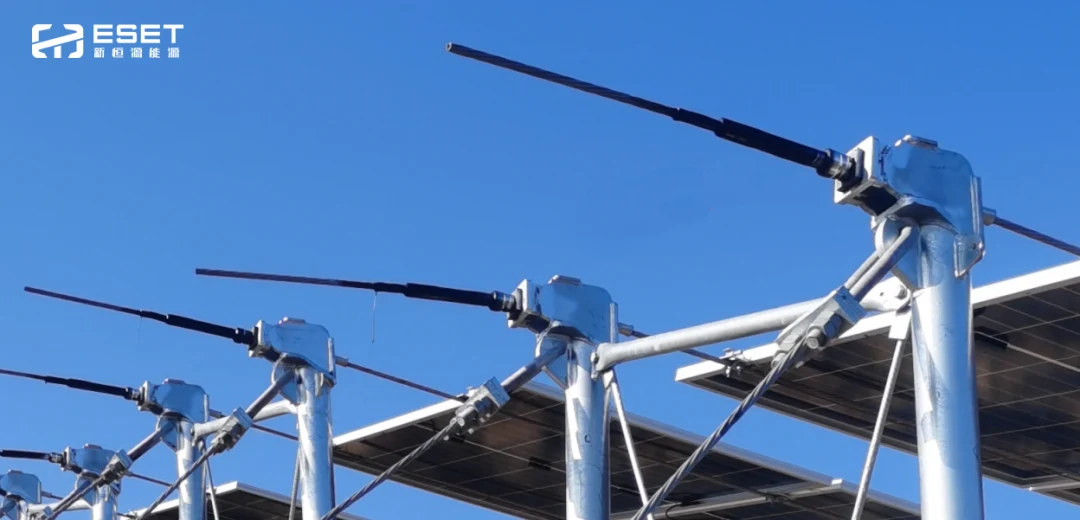
ESET Solar’s first core innovation lies in its adjustable anchoring head.Adopting a ball hinge or multi-directional rotating mechanism, the anchoring head automatically fine-tunes to terrain gradients, delivering multi-angle rotational freedom. This enables steel strands to bear force naturally along a smooth coaxial path, completely eliminating rigid bending angles at the source.
Paired with optimized guiding and limiting structures, the steel strands fit seamlessly with anchoring nodes even under strong wind and intense vibration. Rigid extrusion and reciprocating friction are minimized, effectively reducing fatigue loss from long-term vibration and boosting the durability and structural stability of the entire mounting system.
Instead of forcing the terrain to fit the mounting, we design anchoring heads to conform to every undulation of the land. This achievement stems from profound accumulation in material mechanics and node structural design.
Breakthrough 2: Dual Anti-Displacement Safety Design
In outdoor PV sites such as mountains and wilderness, mounting systems must withstand persistent wind vibration, snow load compression, and over 25 years of corrosion exposure throughout their service life.The industry commonly adopts a single anchoring solution — merely a clip anchor. Though structurally plain, it carries hidden safety hazards. Exposed to humidity, rain, snow and acidic-alkaline outdoor conditions, clip anchors are prone to corrosion and aging, leading to declining clamping force. Once clamping fails, steel strands face the risk of anchor disengagement; under extreme weather, this may even trigger the collapse of entire row mountings, resulting in substantial economic losses.
The inherent limitation of single anchoring lies in point-to-point force bearing alone. Minor displacement caused by clip fatigue or corrosion leads to pre-tightening force attenuation, creating a vicious cycle.
ESET Solar upgraded the design with an innovative combined extrusion anchor and clip anchor dual anchoring system.The extrusion anchor firmly integrates steel strands with the anchor body to form a permanent, stable anchoring structure. It delivers absolute anti-disengagement performance as long as the steel strands remain intact, reliably bearing long-term static loads. The clip anchor, based on the wedge self-locking principle, flexibly adapts to dynamic impact loads such as gusts, buffering external forces and regulating stress distribution.
The two anchors complement each other perfectly: the extrusion anchor guarantees foundational anchoring force and long-term anti-disengagement performance, while the clip anchor buffers and adjusts dynamic external impacts in real time. Even if slight loosening or corrosion occurs on one side, the other maintains stable mounting to preserve overall structural integrity.
The dual-structure double protection mechanism fundamentally eliminates steel strand disengagement risks, greatly enhancing fatigue resistance and impact tolerance of critical nodes, and comprehensively upgrading the long-term stability and safety margin of the entire mounting system.
Furthermore, ESET Solar adopts a three-link three-level restraint design at module fixing ends:
The first level resists uplift tension effectively;
The second level restricts lateral sliding;
The third level delivers encircling clamping fit.
Compatible with various PV module models, it disperses pressure gently to avoid localized overstress. Equipped with anti-loosening bolts and widened gaskets, it reduces contact surface wear and extrusion damage, preventing frame tearing and accessory loss in every detail, and ensuring long-term stability and durability of the whole mounting system.
Breakthrough 3: Multi-Layer Wind Resistance System for Cross-Scenario Application
For large-span and high-clearance scenarios, wind-induced vibration of steel strands and PV modules has long been a major challenge for flexible mountings. Compared with conventional fishery-PV complementary projects, mountings in such scenarios feature higher flexibility and are more susceptible to disturbance from strong winds and gusts, triggering structural resonance and severe swaying.
Prolonged vibration accelerates steel strand fatigue and aging, potentially causing micro-cracks in PV modules and loosening of mounting nodes in mild cases, and endangering the long-term safe and stable operation of the entire PV system in severe cases.
ESET Solar innovatively introduced Tuned Mass Damper (TMD) technology tailored to the characteristics of large-span and high-clearance scenarios to address vibration issues precisely.
This composite multi-layer wind resistance and vibration reduction system is optimized into three coordinated levels based on load characteristics and structural demands of large-span high-clearance sites, forming an all-round defense system against wind and vibration:
Spatial Truss Restraint Layer: High-strength truss mountings, longitudinal tie rods and transverse inter-row reinforcing rods break the independent force-bearing mode of single spans. Multiple spans are integrated into an integral spatial structure, improving out-of-plane stiffness and overall stability. It restrains single-span swaying and multi-span coordinated vibration, reducing vibration transmission structurally to meet force-bearing demands of large-span scenarios.
TMD Energy Dissipation Core Layer: Water dampers are rigidly connected to the mounting via high-strength steel wire ropes. Submerged in water, the dampers leverage the viscous effect of water to provide additional damping. Meanwhile, the reverse inertial force of the TMD mass counteracts vibration energy of the main structure. Ingeniously, water serves both as the environmental medium and a core damping component.
Wind-Resistant Foundation Anchor Layer: Reinforced with superior uplift and slip resistance to withstand negative wind pressure.
The three levels work in synergy to build a complete defense chain of stiffness restraint, energy dissipation and foundation anchoring. Wind tunnel tests and finite element simulation results prove the system effectively suppresses mid-span amplitude and avoids resonance risks, fundamentally solving common pain points such as swaying, shaking and module micro-cracks in fishery-PV power stations.
Breakthrough 4: Full-Lifecycle Anti-Corrosion Protection Armor
To tackle chemical erosion in outdoor environments, ESET Solar abandoned the simplistic single-coating solution and adopted a full-process layered protection system:
Internal sealing barrier on anchors to block capillary penetration of moisture;
External epoxy asphalt shielding layer to resist salt spray and rain erosion;
Heat-shrinkable sleeve wrapping on critical nodes for physical isolation.
This complete weather resistance solution integrates material science and process control, enabling the mounting system to serve reliably outdoors for over 25 years, rather than relying on temporary maintenance and repairs.
Verified by Solid Data Behind Every Breakthrough
All self-developed technologies undergo rigorous multi-dimensional verification, including laboratory static testing, on-site prototype operation and Ansys finite element simulation. Collaborations with prestigious universities such as Zhejiang University and Tongji University mounting professional wind tunnel tests to accurately simulate extreme wind conditions and dynamic force scenarios.
Notably, dedicated TMD wind resistance vibration reduction tests were conducted at the ESET experimental base. A counterweight drive motor replicated the real sway state of flexible mountings under strong wind conditions. Controlled tests clearly demonstrated the outstanding vibration reduction effect of TMD devices: mountings equipped with TMD showed drastically reduced vibration amplitude and stable sway, while structures without TMD experienced dramatic swinging and prolonged vibration. Under equivalent strong wind loads, the stress peak of TMD-equipped mountings remained within the safe range, whereas local stress of ordinary mountings exceeded design limits.
From repeated calibration in laboratories to long-term operation at power stations, from material selection to structural optimization, every effort is dedicated to delivering enhanced mounting stability, reliable power station operation and sustainable clean energy supply.
With technological certainty, ESET Solar safeguards the stable operation of every power station for more than 25 years, consolidating a solid foundation for sustainable returns of PV projects and the steady development of green energy.